Jewelry CAD designer · Matrix
I'm Nazanin Shaterian. Send me a sketch or a photo of your design and I'll build it as a 3D model in Matrix: stones, settings, moving parts and all.
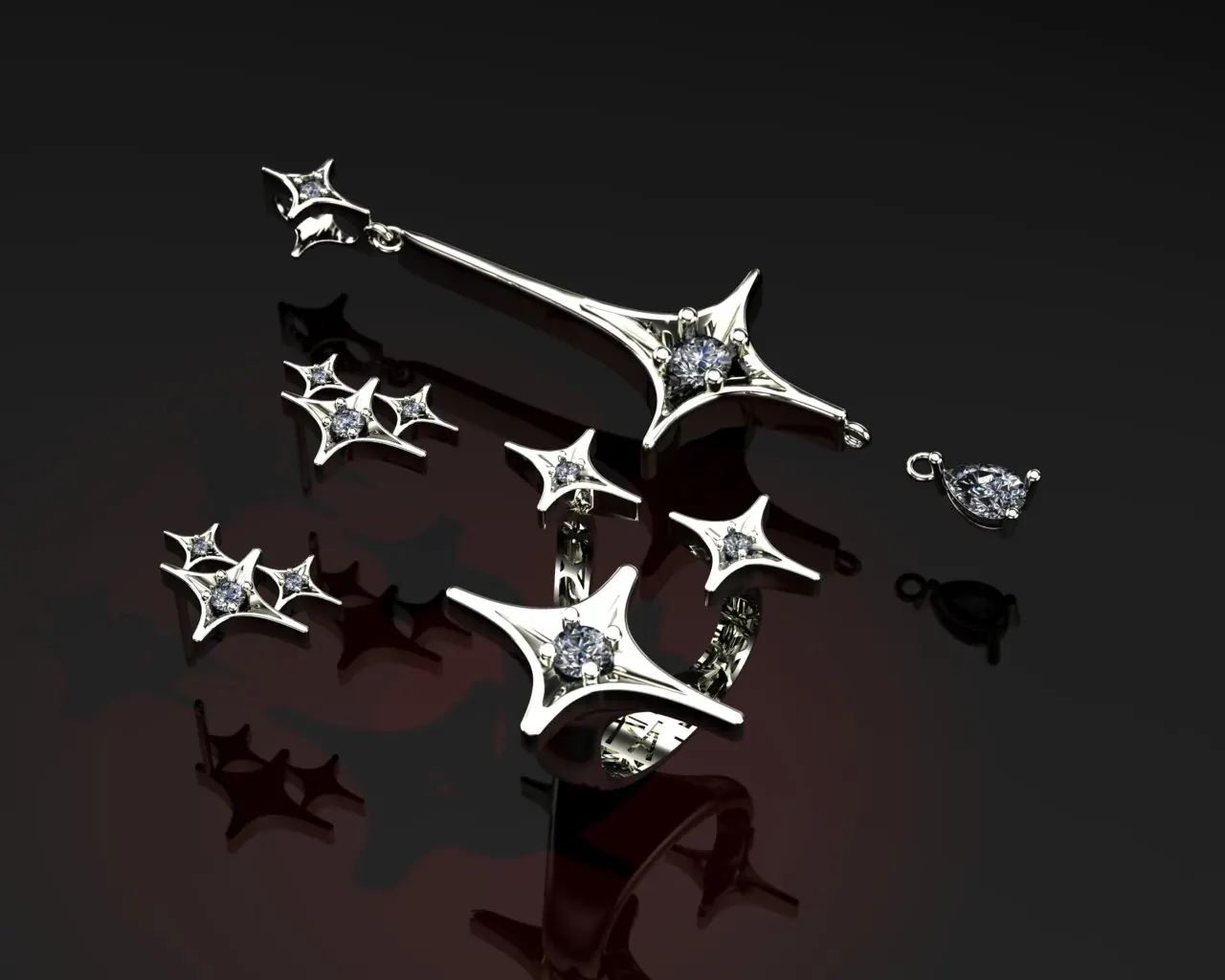
From render to finished piece
Necklace, five medallions


The client brought a reference design and needed it changed, with their own branding added. I rebuilt it in Matrix to their brief. On the rightBelow: the piece after it was made.
Read the case studySelected work
Six pieces. Three open as case studies with the part views; the others open a gallery of every view.


More work
The cross pendant has seats for kite-shaped and tapered stones. The photos show custom-cut stones measured on a grid before their settings are modelled.
Openwork set · bracelet, earrings, necklace
The client drew the idea on paper. Together we made it as light as it could be. It casts as one piece, so nothing needs assembling after casting, yet the links still move. The surfaces are made for bright-cut finishing.
What I model
Every job starts from what you already have: a sketch, a photo or a stone.
-
01
Sketch or photo to 3D
Send a drawing or a picture of the design. I turn it into a 3D file.
-
02
Lightweight designs with a heavy look
Openwork, hollow sections and cut-out backs, so the piece looks substantial and uses less metal.
Seen in: Openwork marquise set -
03
Pieces for bright-cut finishing
After casting, the jeweller cuts thin slivers off the surface with a graver or blade so those faces shine. I shape the surfaces so they can take those cuts.
Seen in: Openwork marquise set -
04
Stone-set jewelry
Pavé, prong and bezel settings, laid out stone by stone.
-
05
Stones set in the wax
Stones placed in the wax or resin model before casting, so the piece comes out of casting already set.
Seen in: Shield and star pendant -
06
Designs for synthetic stones
Settings sized for synthetic stones such as cubic zirconia.
-
07
Mechanical pieces
Sliding, turning and hinged parts that have to move after casting.
Seen in: Sliding-stone pendant -
08
Assembly-ready models
Pieces split into parts that fit together at the bench.
Seen in: Shield and star pendant -
09
Settings for non-standard stones
If your stone isn't a standard cut, send its measurements and I'll model the setting around it.
Seen in: Custom-cut stones -
10
Reference-based modelling
Have a reference piece or a style in mind for your own collection? Send it and I'll model your version.
How it works
Four steps, from your design to the 3D file.
-
You send the design.
A sketch or photo, plus stone sizes and the dimensions you need.
-
I model it in Matrix.
Settings, thicknesses and parts are built for making, not only for the picture.
-
You check the renders.
I send views from several angles. Two rounds of revisions are included.
-
You get the 3D file.
About

I'm Nazanin Shaterian, a jewelry CAD designer. I've modelled jewelry in Matrix for four years and prepare files for production in Materialise Magics. I trained with Mohammad Mortazavi, a jewelry designer who works for well-known brands.
I like the jobs other modellers avoid: a stone with an odd shape, links that have to move after casting, a pendant that comes apart into three pieces. Send me what you have and I'll tell you how I would build it.
Questions
What do you need from me to start?
A sketch or photo of the design, the stone sizes, and any size or weight limits you have.
Can you work from a rough hand sketch?
Yes. A rough sketch with measurements is enough.
My stone isn't a standard shape. Is that a problem?
No. Send the measurements or a photo on a grid and I'll model the setting around it.
Can you keep the weight down?
Yes. I'll design with openwork, hollow sections or cut-out backs.
How many changes can I ask for?
Two rounds of revisions are included.
Send your sketch
Send a sketch or a photo and tell me the piece type, the metal and the stone sizes. I'll reply with how I'd build it and what it will take.
Or write to work@nazaninshaterian.art
Include in your message
- Piece type
- Metal
- Stone shapes and sizes
- Ring size or dimensions
- Deadline